Habakkuk
HABAKKUK Audience Sings the Song, Keep On Believing When you feel weakest, dangers surround, subtle temptations, troubles abound. Nothing seems hopeful, nothing seems glad; all is despairing, oftentimes sad. If all were easy, if all were bright, were would the cross be, where would the fight? But in the hardness, God gives to you chances for proving what He can do.
Let us press on then, never despair. Live above feeling, victory’s there. Jesus can keep us so close to Him that never more our faith shall grow dim. Chorus Keep on believing, Jesus is near; keep on believing, there’s nothing to fear.
Keep on believing, this is the way, faith in the night as well as the day. I’m in a position of having been asked, or asked for a chapel service, which puts you at a great disadvantage to begin with, psychologically anyhow. But I wanted to get some of the material in, in our Minor Prophet’s class where we’re quite short. I figured that I could cover, at least the essence of one book in this manner before the new semester rolls around, so I hope you’ll bear with me—those of you that are not interested in Minor Prophets.
This applies, of course, for both classes, but I want to give you, at this junction, the essence of the Book of Habakkuk. Now in class, I always abandon the notes, push them to the side, close them up and forget them, because I can treat this particular book much better by simply speaking. So it lends itself, I would judge, very well to this kind of an opportunity. Coming into Habakkuk, we’ll begin with the beginning as well as with the end.
In verse 1 of Chapter 1, The burden which Habakkuk, the prophet, did see. The last part of the book, the very last statement, To the chief singer on my stringed instrument. That’s a peculiar text, but in that peculiarity, to me, lies the thrill of the entire book. It’s a book which begins with a burden, and ends with a song.
Hallelujah! The book which begins with a burden and ends with a song, and within these two extremes, we have the secret of God’s way of turning our burden into a song. Many an experience in life begins with a burden. You think you never get over it, never come out from under it, and when the final note is reached, lo and behold, it has changed to a note of song, to a note of triumph.
I feel (I feel!), I know in this book we have God’s secret of turning our burdens into a song. The question is, “What is it?” Coming now to the beginning of the chapter, you notice there the word, “burden.” Now you go to books (I do), and they will tell you there that the word means “a vision or a revelation.” Alright, I grant you that, but I think that the context makes it very clear that with that vision, there was also in the heart of the prophet precisely what the word implies: a burden.
You read the first chapter and you find this man is bent down, so to speak, at least in his spirit, in grief, in care, in perplexity. Here we find the prophet Habakkuk perplexed, and in that perplexity he feels burdened; he feels heavy; he’s under a load, under a stone. In German we say (he gives a German statement), “He has a stone on his heart.” If I talk to you and have a stone on my heart, you’d say, “Who, what?” But over there it makes sense. It simply means that there is a weight, something that presses you down.
So Habakkuk is burdened, pressed with care, befuddled with perplexity. There is something the man cannot figure out, and what the man cannot figure out is what God does. Does God ever do things with you that you can’t figure out and they puzzle you? Well Habakkuk is puzzled, and he’s puzzled about three things—three things that constitute his burden and his perplexity.
(Now, well we’re partly in class, aren’t we?) There are three key words to this book: In verse 2, the words, how long; in verse 3, the word, why; in verse 13, the word wherefore. This prophet’s mind is full of questions, that is to say, three questions—but they fill his mind—and the man has no answer to either one of the three questions. How long? Do you ever say that?
Oh God, how long—whatever you have in mind. The prophet said, Oh God, why. Does anybody have a why this morning? “God, why do You do this to me?
Why don’t You do thus and so? Why do You allow such and such—why? The prophet had a why—in verse 13, wherefore, which is quite similar. How long, why, wherefore?
What did he have in mind in each of the three? How long shall I cry and thou wilt not hear? Do you know what perplexed him here? The problem, the old age problem—old age (laughter).
Is that the work of the sub-conscience mind? The age old problem (still laughter)—which is right now, the age old problem. Is that right? Yea!
The age old problem of unanswered prayer. How long have people prayed for the salvation of a loved one—no salvation. I know a good pastor, used to be pastor, whom all of you know, with a very ungodly son—and very is the word. They have been praying for decades for God to save that boy.
So far, there hasn’t been the least sign. How long? Do you ever pray that way? Oh God, how long?
The prophet is burdened. He said, “God I cry, but You don’t hear.” Well God hears, but He doesn’t answer. That’s quite a subject: unanswered prayer. But we can’t go beyond that at this point.
Why doest thou show me iniquity? In other words, “God, why do You let things go on as they do? Look at the violence, look at the strife, look at the commotion, look at the contention, look at the wicked. God, why do You allow things to go on?
Why do the wicked prosper? Why don’t You do something? Why don’t You judge them? Why don’t You undertake?
God, how about it?” But there is no answer. Remember the preacher who fasted to stop the march of communism and died of hunger? People say, “God, why does God allow wars? What about Russia; what about the atomic missiles, what about this?
Why doesn’t God put a stop to it all?” Well, after awhile you learn not to ask such foolish questions. But it bothered Habakkuk. Wherefore lookest thou upon them that deal treacherously, and holdest thy tongue when the wicked devoureth the man that is more righteous than he? Hab. 1:13.
What bothered Habakkuk here was the suffering of the righteous. That’s another age old problem. Is that right?—old age, age old problem—the suffering of the righteous. Why God, just look at Your people.
Look at what they go through, and look at the wicked. They prosper; they have Cadillacs; they have summer homes; they have winter homes; they have everything, and look at Your poor people over there. God, how is that? How long, why, wherefore—and the prophet is bowed down with care, filled with perplexity, has a stone upon his heart, a burden, and feels so heavy.
Now in chapter 2, verse 1, he does what many Christians, in their perplexity, fail to do. This is an exaggeration, but the average Pentecostal person apparently, when they have a burden, they run to every Tom, Dick and Harry to find an answer. I’ll tell you, “Tom, Dick and Harry often just doesn’t have the answer.” Habakkuk did what I would highly recommend, namely, he went to God. We have to learn to go to God with our problems, but you know what folk do?
They have a problem, and they want a certain answer. Get it? So they go from one door to the next. Sound of knocking.
“What do you think I should do?” Ugh? He don’t know—nothing. Knocks again, “What do you think?” She don’t know nothing either. Knocks again, “You know that’s just the way I felt, thank you very much.
Now I know what to do.” All they do is look for confirmation for what they have already determined, and go shopping for an answer until they find it. You’ll find it. You just go to the flea market. Habakkuk went to God.
What’s wrong with going to God? Over the holidays I had such a pressing problem, oh so pressing! And the Lord whispered way down in my heart, “Amen’t I your counselor?” I said, “You know, that’s right.” I will stand upon my watch and set me upon the tower and will watch to see what he will say unto me, and what I shall answer when I’m reproved. Habakkuk 2:1 He expected some kind of a rebuke.
That reminds me of Brother DBR. He wanted to hear God’s audible voice and kept pressing until God rebuked him that he said, “Oh God, I don’t want to hear it no more.” (laughter) That’s a foolish request, isn’t it? I will stand upon my watch. Habakkuk went to God.
He said, “I’m going to go to this God, and I’m going to wait for an answer and see what He’s got to say, and if I’m rebuked, I’m rebuked, but I’m going to get something from God.” And he did, but he got what he wasn’t looking for. Look here, Habakkuk went to God in order to get an answer to his question. To me, the beauty of this is, God never answered one of his questions. God gave Habakkuk an answer.
It says here, verse 2, and the Lord answered me and said. But God’s answer did not consist of an explanation, an answer to the questions he asked. God’s answer consisted of the solution to his problem. You might say, “What’s the difference?” There’s a big difference.
The solution to our problem, especially relative to divine providence, does not necessarily, and is not likely to lie in an explanation, but rather in a meeting of the basic need. What Habakkuk needed was not an explanation, an answer to his question, but a solution to his problem, and the solution did not come by an answer to his question. Now get that—this takes us to the core of the lesson. “Lord, how long—six days, six weeks, how long?” God passed his question by altogether, and yet answered his problem.
His question was only symptomatic of a deeper problem, and if the deeper problem could be met, the symptoms would disappear. That’s something I like about God. There’s lots of things I like about Him, but God deals with causes not with symptoms. Oh, the mistakes that get made in Christian work, always dealing with symptoms with effect—change the effect; do away with effect; forget the effect.
The effect is only a symptom of the cause. Deal with the cause and the effect takes care of itself. I don’t know anything about dogs, but they tell me when a dog’s nose is hot, he’s sick. What would you think if I had a dog with a hot nose and I’d say, “Let’s get an ice bag and hang it on his nose because we got to cool it down—it’s a sign of sickness?
Oh my look how cold his nose is now! He’s alright.” He’s not alright—you changed the symptom, but the cause is there. God deals with causes. Habakkuk’s questions were symptoms.
The answer to those questions did not solve his problems. God had to get way down to the thing that caused them. So God did not give him an answer to his question, but a solution to his problem. Alright, what’s the solution?
The Lord answered and said, (and among the things He said) Behold his soul (that refers to the Chaldeans over which Habakkuk had complained) which is lifted up is not upright in him. God is saying, “Habakkuk, I know those Chaldeans aren’t alright; I know they’re proud; I know they’re conceited, but never mind, don’t you bother with them.” The just shall live by faith. Doing a little work on this, I have found that you can translate it like this: But the just shall live by faith in His faithfulness.
Look at God’s cure. He said by implication, “Habakkuk, you don’t need an answer to how long, to why or to wherefore; that doesn’t solve your problem.” My guess would be that would only intensify it because the answer to one question generates new questions. “Oh no, that isn’t what you need, Habakkuk. I’ll tell you what you need.
You need faith in My faithfulness.” Do you know that works? The just shall live by faith in the faithfulness of God. When that faith in God’s faithfulness, in spite of everything else that takes hold, the question aren’t answered, they are dissolved. Do you get it?
The questions cease to be. There just won’t be any, not like this, questions that question the providence of God. They’ll just stop. The just shall live by faith in the faithfulness of God.
Look here, God is actually calling for a faith which is anchored, not in what God does (get that), but in what God is. I hope you see the difference. People say, “Oh, I believe God. Why you know, presto, church-o, bingo!
He healed me. I believe God because He healed me.” There’s a better faith than that: a faith that believes in God when He doesn’t. (Sarcastically said): “Well, I don’t believe that.” Then you’re missing something. That’s a little too much, isn’t it?
I’m not saying God doesn’t heal. Oh no! But what if He delays your healing? (We’ll just put it that way.) What if He waits?
“Well, I don’t believe He would.” Well, a lot of people don’t believe. The just shall live by faith in his faithfulness. God wanted Habakkuk to have a faith in God that was based, that had its foundation, not in what God did or didn’t do, but in what God was—in other words, in God’s integrity irrespective of what He did or didn’t do. That’s faith!
Job had it. Mrs. Job said, “Hey old man, curse God and die. Look at the mess you’re in.
Ugh! Ugh! All I see you do is ugh, ugh, ugh. That’s all I see every day.
I’m sick and tired of it. Curse God and die.” “Woman, though he slay me, yet will I trust him.” That’s right! When God got done, after keeping that man scratching for over a year, they tell us, God heals. Can you imagine the faith that man came out with from that experience?
When I speak thus, I’m not implying a negation of the promises of God, I’m merely implying the thing that Job went through, Though he slay me, yet will I trust him.—A faith that is not just anchored in what God does in a speedy answer to prayer, but in a faith in what God is in spite of what He does. That’s the faith tried by fire. Message in tongues & interpretation. Yea, did not the Hebrew children, when they stood before the fiery furnace determine in their hearts.
They said, “Oh king, if our God will deliver us, let it be so, but if not, we will still trust him. If He will bring us out of this fiery furnace, let it be so, but if He will not, He will yet bring us. Why? Because they trusted in the veracity and the faithfulness of their God.
They had seen Him work and knew that He made no mistake. And how can the clay say unto the potter, “What makest thou, and what is thou doing?” If thou wilt submit thy life unto God and let Him work according as He wills rather than letting thine own reasoning or understanding try to enter in and try to figure a way out of that which God has put you, you would come forth as gold refined. But thy God doth use the experiences of the furnace and fire in thy life, and He would bring thee into those deep places where the waters are deep and the circumstances may be entangling.
And yet, He would ask thee to lift up your eyes unto Him and to behold Him in all His glory and majesty, for has captives worthy of His mantle upon you. Throughout the ages, and today, this same God doth hold thee in the very center of His hand, and He will not leave thee nor forsake thee, but He is asking thee to allow Him to work in thy life by yielding thyself in simple faith unto Him, for thy God will not leave thee. He will not forsake those who trust in Him, but He will bring those that trust in Him out of the experiences of which He has brought them, but He will bring them out in pureness of gold and they shall shine forth as a light in the darkness.
And thou wilt be able to minister to others who are down and are going through the deep places because thou hast experienced the hand of God in thy own life. Yield to thy God today in whatever circumstance He has placed thee and see His face, see His eye directing thee, and allow Him, through sheer faith in His word, to guide thee out, and when He has tried thee, He shall bring thee forth. (Praise and worship from the audience.) Do you see how God resolves Habakkuk’s problem?
Not by explaining what He did and why He did or why He didn’t. Not a word, God just brushed that by—and yet He answered. The just shall live by faith in his faithfulness in spite of what He does or doesn’t do, even though when circumstances appear to be the very negation of His word. Faith still says, “I’ll believe what He said.” Whew, that’s faith!
Alright, Habakkuk heard. In Chapter 3, verse 2, Oh Lord, I have heard thy speech. Oh, he heard. Look here folkses.
He didn’t only hear, he heard. Do you know you can sit in this chapel and hear every word I say and hear nothing? Jesus said, They have ears and hear not. Didn’t they hear what He said?
Of course they did, but they never heard. They never heard in there (pointing to heart), and as a result, they might as well not have listened. That’s right! But he heard, Oh Lord, I have heard thy speech.
He said, Yes, I heard, and was afraid. God came from Teman and the holy one from Mt. Paran, Selah (still, pause). His glory covers the heavens, and the earth was full of his praise.
Look at the man! Something’s happened. In the beginning, Oogh (sigh). Oh God, how long, why Lord, I can’t understand.
Now he talks different. Now he recites what God did, something clicked. Do you know what he’s doing in chapter 3? (And I won’t keep you past lunchtime, so please don’t get nervous.) Do you know what do does in chapter 3?
He now recites the past acts of God. All the way down: God marched and God went through the land, and God did this, and God did that. Faith is springing up, partly because he heard (that’s the main part), and partly because he’s now reciting to himself the past acts of God. Do you know it helps to recall what God did for you?
When you’re pressed along this line? You folk sometimes walk into my office, and you see things hanging on the walls. People think they are souvenirs—they’re not souvenirs. No, they’re not souvenirs.
There is something from Africa, there’s something from South America, there is something from Indonesia, there is something from somewhere else. They’re not souvenirs; they preach to me day after day. When my faith is low, or when I need more faith, I just sit there, maybe lock the door so nobody walks in on me, and I just look at them. My, what God has done!
I review the works of God and faith is strengthened, and I say, “God, what You have done in times past, You’re able to do now.” Praise God! I look on my map, not in self-congratulations, Oh no. My what a God! Oh God, how great Thou art!
Faith springs up and you feel like sitting there and singing that chorus, “How Great Thou Art.” How about singing it—I’m not finished, but let’s sing. Audience sings the song, How Great Thou Art. Then sings my soul, my Savior God to Thee, how great thou art, how great thou art. (2 times) Hallelujah!
Praise God! Praise God! You know when you consider the greatness of God, you get so small. Do you ever get that feeling?
You get smaller and smaller and smaller and smaller. It’s humiliating to contemplate the greatness of our God. Does He have that effect on you? He does on me; just shrinks your size.
Well Habakkuk rehearses what God did. And now in verse 17: Although the fig tree shall not blossom. Look at his language: how different from how long, why, wherefore. Now he says, “It doesn’t make any difference any more what God does, or what He doesn’t do.
It doesn’t matter at all. Although the fig tree shall not blossom; neither shall fruit be in the vines; the labor of the olive shall fail and the fields shall yield no meat; the flocks shall be cut off from the fold and there shall be no herd in the stall, yet I will rejoice in the Lord. Hallelujah! That man has changed.
Now it doesn’t matter what God does or what He doesn’t do; doesn’t make any difference to me, my joy is now anchored in God Himself as a Person, not in His acts, but in what He is. That’s the only real foundation for faith. What has happened to the man? He has entered the rest of faith.
No more questioning; no more burden; no more perplexity; no more struggle—it doesn’t matter. Either way is alright with me, I’m now rejoicing in Him, irrespective of what He does; in spite of what He does or doesn’t do. Do you see how faith has anchored that man in God Himself as a Person? How many people’s faith lies solely in what God does—and when He doesn’t, down they go?
His faith doesn’t let you down. His faith makes you stand, but there’s nothing left to stand, but what God has said—and that faith says, “That’s good enough for me.” That’s right! Yet I will rejoice in the Lord (in spite), I will joy in the God of my salvation. The Lord God is my strength.
He has entered the strength of faith. Hey, this faith is strong. No more, “Ogh, I’ll tell you, I might as well quit.” No, the Lord God is my strength. He will make my feet like hinds feet.
He will make me to walk upon mine high places—the walk of faith. This is the walk of faith that walks with God in spite of what He does or doesn’t. Hinds feet—that’s the mountain goats, the goats with long hind legs and a very sure footing. They run up crevices just about this angle.
When the mountain lion is after them, they escape the mountain lion. By the way, those of you who always like to be in the mountains, there’s a lion up there too! (Laughter) There mountain lions, yes there are. They have them over there in the Eastern countries, and they’re right up there where some people like to be up in the mountains all the time and never go down to, you know, where it’s nice to walk with the Lord too.
But these goats are so skilled (skilled perhaps isn’t the word, I don’t know) on their legs that when the mountain lion comes, they’re able to run up steep cliffs, jump over wide crevices and escape the mountain lions. This faith enables you to escape the mountain lion—the enabling of God within faith so we can with surety climb over steep and dangerous mountain areas, He will make me to walk in the walk of faith. Back in the Old Testament, where is it, Joshua, Judges?
I think it was the tribe of Dan. Their enemies drove them up into the mountain, and it says they couldn’t come down. Have you ever known of people that get driven up by the enemy into a mountain peak of glory and can’t come down, ever, to where people’s needs are? There’s danger up there.
Stay too long and the lion is going to get you! Then he says, to the chief singer on my stringed instrument. Let’s get this into perspective and then we’ll close. You have here in 17 through 19 these aspects of real faith.
The rest of faith—it doesn’t matter any more what God does; the joy of faith; the strength of faith; the walk of faith; and the last statement, to the chief singer. Hallelujah! Do you see it? The song of faith.
Habakkuk said, “Hallelujah! Glory! I don’t care anymore what God does or doesn’t do; I just rejoice in what God is. Brother Krenkle, would you take this song down for it right now, and we’ll sing the song of faith?
That’s Brother McIlvine, he went over to the choir leader and the orchestra and said, “Hey, come on, here’s a new song.” How about a new song? How about a new song—a song of faith that sings, “I know that my Redeemer liveth,” and it seems He’s turned His back on you and is going the other way, and you say, “I don’t believe it.” Whew. How about songs in the night? This gives you a song in the night.
Hallelujah! I could shout! To the chief singer on my stringed instrument, to the choir leader, the orchestra leader, the song free. What faith?
The rest of faith; the strength of faith; the joy of faith; the walk of faith; the song of faith. What’s the title of this song? The triumph of faith over all the perplexities that arise from God’s providence. The book that began with a burden, ended with a song through the secret of faith in the integrity of God irrespective of what He does or doesn’t do.
Shall we stand? Praise God! Glory be to God! (Much praise given to the Lord from everyone, a real time of worship.) Walterbeuttler.com
This message is one of the sixty-six surviving transcripts of Walter Beuttler's teaching. To hear his voice, visit the Messages page. To read the story of his life — from the Brooklyn Bridge to the school of the Spirit — see Who Was Walter Beuttler? The True Story of the Man Who Knew God.
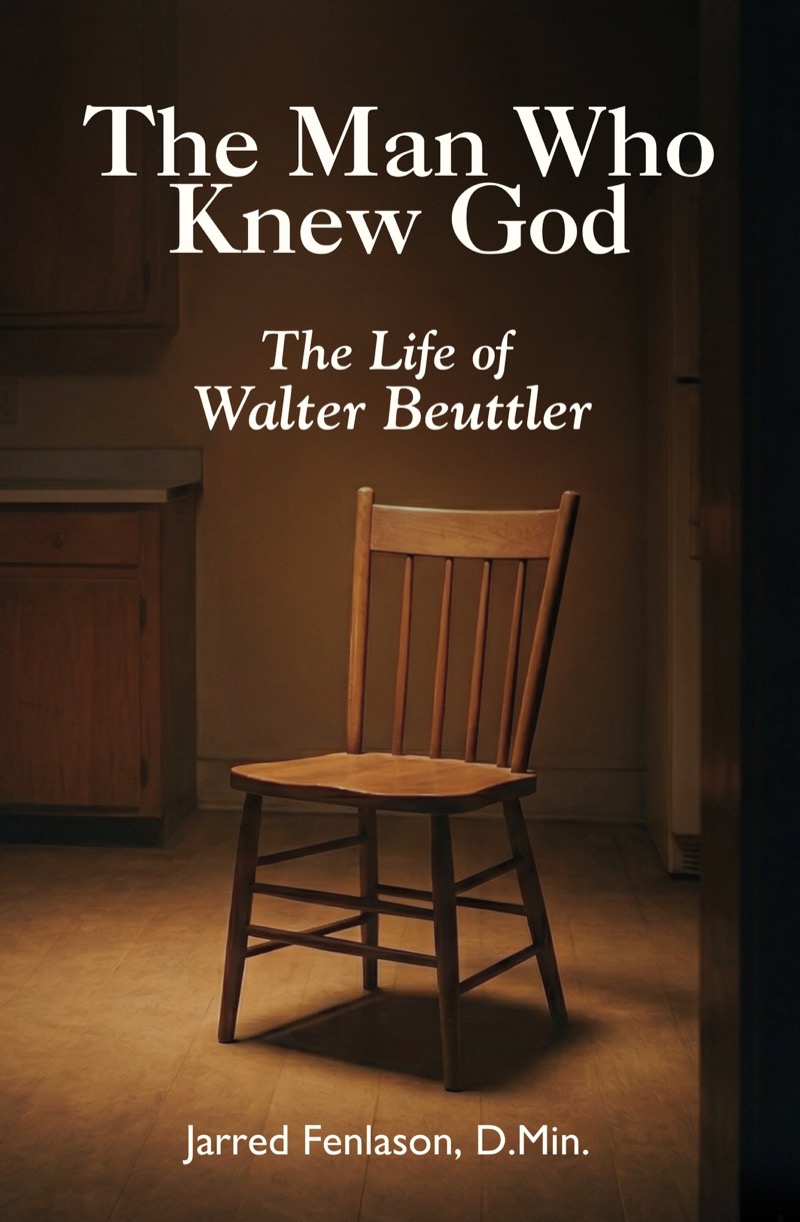
The Man Who Knew God
Walter Beuttler was never famous, yet he carried God's presence to more than a hundred countries. His students said that when he walked into a room, the air changed. This is the first full account of a friendship with God that was specific, sustained, and costly. Read the story of his life →